

What is a benefits decision support tool?

A benefits decision support tool helps employees choose coverage during the limited time they actually spend on it, gives employers plan-accurate support without adding administrative work, and gives advisors a way to scale that support across their book of business. The strongest tools don't stop at a quiz-style recommendation flow. They combine plan-accurate guidance, year-round employee support, and the operational workflows that keep teams moving.
What is a benefits decision support tool?
A benefits decision support tool is software that helps employees understand their options and pick coverage that fits their situation. The strongest tools do so with plan-specific content, plain-language explanations, and guidance tied to the employee's real plan options, not a generic recommendation based on averages.
The category has expanded over the past few years. What used to be a standalone enrollment quiz is now expected to support the administrative work behind enrollment, too: content creation, communications, document handling, and ongoing employee questions. The best employee benefits decision support tools work for the employee making the decision and the team supporting that decision.
Why does picking the right tool matter so much?
Most employees don't have much time to make a benefits decision, and the consequences of getting it wrong show up later. EBRI found that about half of enrollees spent less than an hour reviewing options during open enrollment, and that benefits guides remained the most-used resource in plan selection.¹ In that hour, an employee might pick a high-deductible plan without realizing their family's expected care would have been cheaper on a PPO, or skip an HSA contribution they'd have made if anyone had walked them through the triple tax advantage.
Affordability pressure makes this harder. In the same EBRI survey, 4 in 10 privately insured adults said their health care costs increased in the past year, and cost was the leading reason adults delayed or avoided care.¹ Employees are choosing benefits under both time and money pressure. A static benefits PDF and an overloaded HR inbox aren't enough support for that level of need.
What makes the best benefits decision support tool?
We've been doing this work for years — building benefits guides, microsites, decision support, and AI-driven employee support inside one platform across thousands of employer deployments. Five things consistently separate a tool that helps employees and reduces team load from one that just adds another login. We're sharing them because most evaluation conversations skip past these and focus on the recommendation flow alone.
Here's the framework, in order of what tends to break first when the standard isn't met:
1. It uses plan-accurate content
Generic recommendations break down the first time an employee asks about their employer's specific HSA match, their carrier's mental health network, or a carve-out their plan handles differently. A strong platform works from the employer's actual plan documents, eligibility rules, and carrier materials, so employees get answers tied to the coverage they're choosing between. If the content isn't plan-accurate, everything built on top of it inherits the same problem.
2. It supports employees year-round
Decision support that disappears after enrollment misses the part where employees actually use their benefits. A qualifying life event in April, a claim denial in July, an HSA question in November — these all sit outside the open enrollment window, and all generate support requests. Year-round support means employees can self-serve those questions instead of waiting on an HR team that's already stretched.
3. It helps employees act, not just learn
Many tools explain benefits and stop there. The employee reads the info, understands maybe 60% of it, and still doesn't know which plan to elect. Others start the experience with a long intake form — income, dependents, expected utilization, risk tolerance — and only produce a recommendation after the employee has spent fifteen minutes on a setup quiz. Both patterns lose people.
The right tool gives the employee something useful the moment they land, then lets them refine. Pasito is the leading platform on the market that opens with a proactive recommendation tied to the employer's actual plans, before the employee fills in anything. From there, employees can compare two real options side by side, understand the tradeoff in language they can use, and move toward a decision they can defend to themselves a month later.
4. It reduces manual work for employers and advisors
A benefits tool that improves the employee experience while adding work for the team behind it is a wash. The platform should consolidate the workflows that currently live in spreadsheets, email threads, and one-off documents: communications, guide generation, intake, and employee support. If it doesn't, you've just added another tool to your stack.
5. It produces measurable outcomes
The right platform should change something you can measure: engagement at open enrollment, election rates on supplemental coverage, support volume during the busy season, HSA contribution levels, the time the team spends on repetitive plan questions. Vendors should be ready to show those numbers from real deployments before the contract conversation gets serious. Pasito works with organizations managing billions in premiums and supporting millions of employees, and the platform's outcome numbers update there as deployments grow.
How should employers and advisors evaluate these tools?
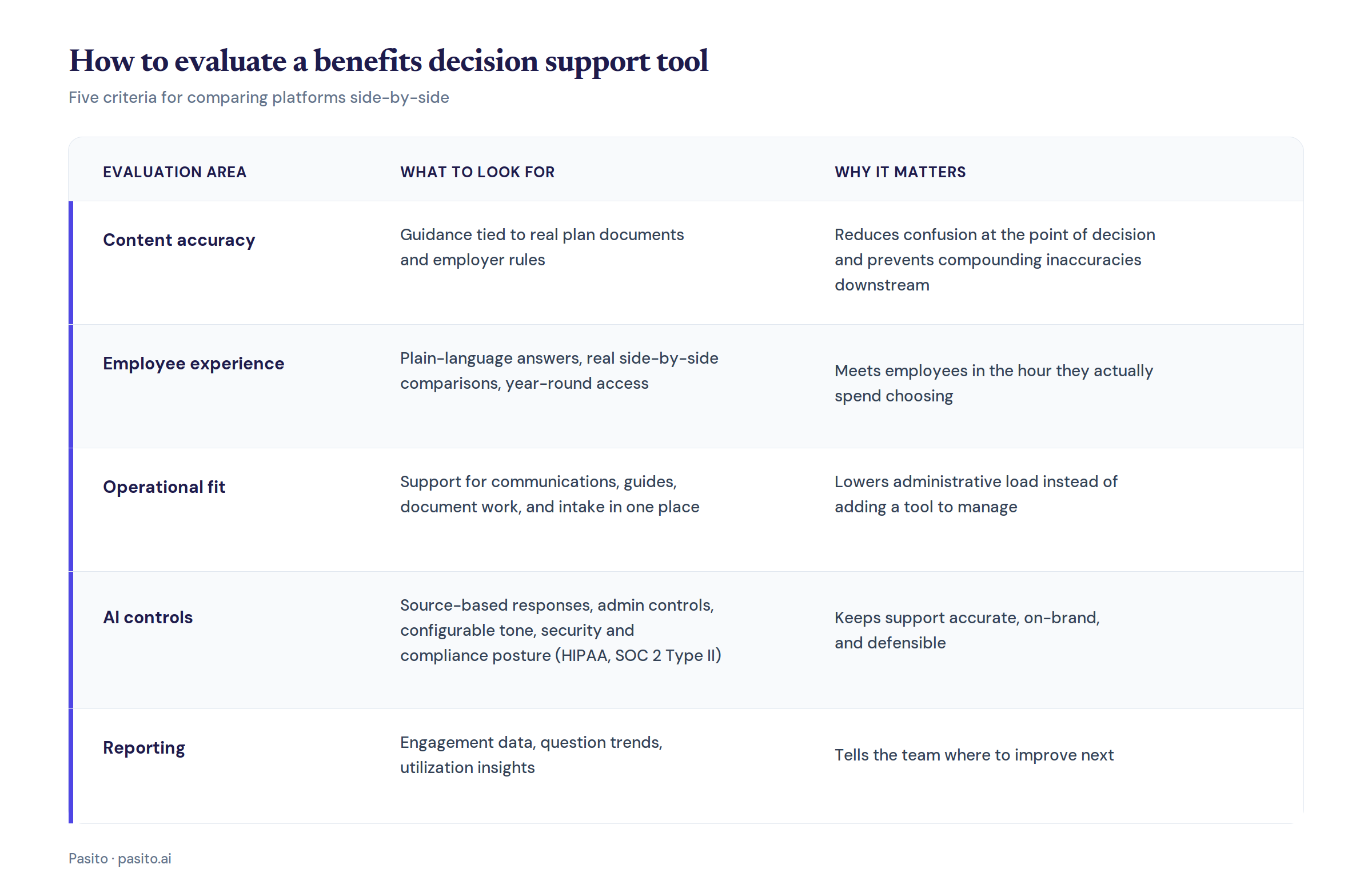
These five standards are the framework. Here's how to apply them side-by-side when you're comparing platforms.
Where do most tools fall short?
Most benefits decision support tools still treat enrollment as the whole job. They invest heavily in the recommendation flow and leave everything around it to other systems: separate content tools, separate support channels, separate engagement workflows. The employee gets a clean experience for two weeks a year and a fragmented one for the other fifty.
That gap matters because of how employees actually use benefits information. EBRI found that benefits guides were the most-used resource in plan choice, not interactive tools.¹ And LIMRA's BEAT study found only 54% of employees feel their employer communicates benefits details very or extremely well — meaning nearly half of employees are left underserved by the status quo, and most decision support tools aren't built to fix that.² Employees rely heavily on content and explanation. If the platform can't generate that content, answer the follow-up questions, and support the team producing it, it's solving a sliver of the problem.
Why we take a broader approach at Pasito
We built Pasito as an AI-native workspace for benefits because the work around the decision is the work. Better decisions don't come from a slicker recommendation engine. They come from accurate content the employee can read in the hour they actually spend on this, support that's available the next time they have a question, and operational workflows that don't bury the team behind them.
Inside our platform, that looks like:
- Personalized guidance for employees, built from each employer's actual plan documents so the recommendation matches the coverage on offer, not a national average
- An AI benefits assistant trained on those same plan documents to answer employee questions year-round, in plain language
- Back-office automation for the data entry, document creation, and client setup that currently eats team time
- Benefits guides, microsites, and engagement campaigns generated by AI agents from the same source of truth as the rest of the platform
- Analytics that show employers and advisors where engagement is breaking down and what to do about it
Pasito helps benefits consultants extract plan information with AI agents, build client resources in minutes, and answer employee questions year-round — reducing the volume of repetitive work that currently eats team time across the book. That changes the math for employers trying to contain support costs and for advisors trying to scale service across more clients without adding overhead.
In conclusion
The best benefits decision support tool isn't the one with the sharpest enrollment quiz. It's the one that helps employees make confident choices in the time they actually have, gives employers plan-accurate support that holds up year-round, and gives advisors an operating model that scales across their book.
If you're evaluating tools now, start with the workflows generating the most manual work and the most downstream confusion. That's usually where the case for a broader platform becomes clearest. When you're ready to see what that looks like in practice, we can show you how Pasito handles decision support inside one connected workspace.
FAQ
What is the best benefits decision support tool?
The best benefits decision support tool combines plan-accurate guidance, year-round employee support, and operational workflows that reduce manual work for employers and advisors. The strongest platforms don't stop at the enrollment quiz; they support the work around the decision too.
How do employee benefits decision support tools work?
They help employees compare benefit options, understand tradeoffs, and choose coverage based on their situation. More advanced platforms also support communications, content generation, and employee questions after enrollment closes.
Why do employers need benefits decision support?
Employees often spend under an hour choosing coverage, and the consequences of a wrong choice show up in lower utilization, more support requests, and lower satisfaction with the benefits program.¹ Good decision support improves clarity at the point of decision and reduces administrative strain on the team behind it.
What should advisors look for in a benefits decision support platform?
Advisors should look for plan-accurate content, scalable employee support, reporting that shows what's working, and workflow support that helps them serve more clients without adding manual effort across the book.
References
- Employee Benefit Research Institute, "Health Care Affordability Pressures Persist for Privately Insured Americans," March 2, 2026. https://www.ebri.org/docs/default-source/ebri-press-release/pr-1388-cehcs25-2mar26.pdf
- LIMRA, "2024 BEAT Study: Benefits and Employee Attitude Tracker," June 2024. https://www.limra.com/en/research/research-abstracts-public/2024/2024-beat-study-benefits-and-employee-attitude-tracker/

Andrew Kut brings to Pasito extensive experience in digital marketing and educational content writing. His background includes leading content strategy across a variety of industries, including large global financial institutions and AI-powered health benefits administration. He holds a B.S. in Digital Advertising from Missouri State University.
Want more resources in your inbox?
Get all the latest industry insights and resources from Pasito every month. We promise you’ll like what you see.
Related posts

The open enrollment checklist consultants can hand their clients
